
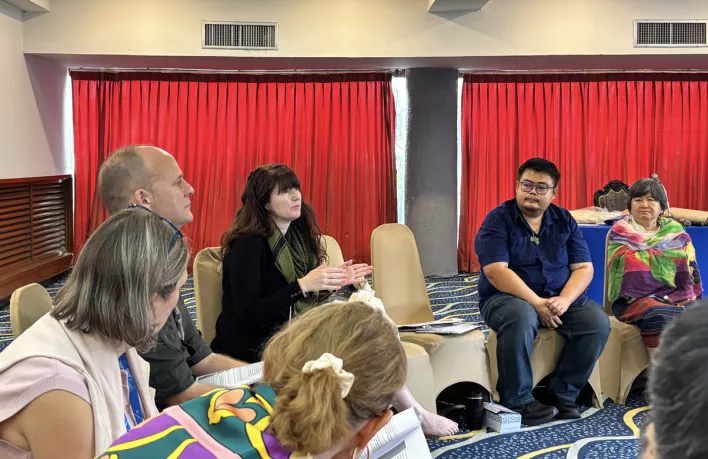
These pressures set the context for “Defender Alerts: Forecasting Risks with Preventive Protection for Community-Led Development,” a workshop IAP (International Accountability Project) co-organized on October 13, 2026, with the Business and Human Rights Centre, the Coalition for Human Rights in Development, Indigenous Peoples’ Rights International, and Peace Brigades International. Held on the second day of the International People’s Assembly in Bangkok, alongside the International Monetary Fund and World Bank Annual Meetings, the workshop brought together human rights lawyers, practitioners, activists, and civil society representatives from Bangladesh, India, Indonesia, Italy, Kazakhstan, Laos, Nepal, the Philippines, Thailand, the United States, and Zimbabwe.
Participants shared experiences supporting communities affected by development projects, particularly those promoted as part of the “green transition.” Their discussions explored how investment information and community knowledge can support preventive action for defenders working on climate, energy, and transition minerals.
Danilova added that the policies and investments of development banks, including the World Bank Group and the International Monetary Fund, can create or intensify these pressures through economic reforms, fiscal austerity, privatisation, and support for large-scale development projects. “When communities resist, those defending their land, labour rights, and environment can face intimidation, criminalization, and other forms of retaliation,” the Peace Brigades International representative said.
“Access to information before projects advance can therefore be crucial to helping communities anticipate risks and organize their responses.” she said.
Access to information can change communities’ responses
Tom Weerachat, IAP’s Deputy Director, then invited participants to reflect on how early access to information could strengthen community-led action.
“What would you and your community have done differently if you had known about a proposed development project months in advance, including who was involved and whether they had caused harm elsewhere?” he asked. Tom Weerachat, IAP’s Deputy Director, inviting participants to reflect on how early access to information could strengthen community-led action.
For communities living near development projects, access to information is not just an administrative formality. It can determine whether people have enough time to understand potential impacts on their land, water, livelihoods, health, and environment; seek independent advice; raise concerns; and meaningfully participate meaningfully in decisions.
“Usually, information regarding the projects is very limited for communities,” said a participant from Kazakhstan.
Alongside limited access to information, participants identified that the absence of free, prior, and informed consent (FPIC) by affected Indigenous communities is a recurring concern across countries. A participant from India highlighted a different but related challenge: “the problem is also because of too much information circulating and polarizing communities.”
The discussion explored how development actors promote narratives of “green projects for a greater good,” making it harder for communities to question potential harms and the distribution of benefits. Participants also discussed the role of private companies in these investments, a pattern examined through IAP’s Transition Minerals Finance Tracker and Energy Finance Tracker.
“In my country, Zimbabwe, we still want to see a single development that comes as the result of these projects which take place where local communities live. I don’t see the profits being translated into welfare. “Where is the compensation?” said another participant. the one participant from that African country.
These experiences connected the workshop’s discussion of preventive protection with broader questions of climate justice: who benefits from investments, who bears their costs, and whether communities can influence the decisions affecting their lives.
Turning early warning into preventive action
IAP’s work on defenders addresses the harassment, violence, and criminalization communities can face when protecting their land, livelihoods, and rights. Investment disclosures, although often incomplete or inaccessible, can create an opportunity for communities to identify risks and prepare a response before harm occurs.
Defender Alerts combines investment data from the Early Warning System with information from civil society partners to assess proposed and newly approved investments. The analysis considers project sectors, financiers’ risk assessments, civic space, companies’ human rights records and commitments, and institutional safeguards. Alerts are shared through secure channels to support community-led protection planning, early advocacy, and engagement with decision-makers.
For communities and defenders working on climate, energy, and transition minerals, this approach connects information about investments with opportunities to act. It can help identify the actors behind a project and anticipate risks that may otherwise become apparent only after communities experience harm.
Protection must guide advocacy at every stage
Toward the end of the workshop, Tom walked participants through the Defender Alerts format and invited suggestions on how to strengthen distribution and mobilize preventive action.
Participants emphasized that alerts need to be accompanied by coordinated strategies across different levels of decision-making.
“We can also carry out advocacy at the local level by engaging with local governments to put pressure on them to support the demand of affected communities through resolutions, and also with local media to make the concerns of affected communities visible to the wider public”, said Joan Carling, IPRI Executive Director.
She also emphasized the need to assess the risks associated with protection mechanisms and advocacy, not only at the beginning, but also after an advocacy goal has been achieved. “We need to be careful when doing advocacy, especially when we want to support representatives of affected communities in the international advocacy process”.
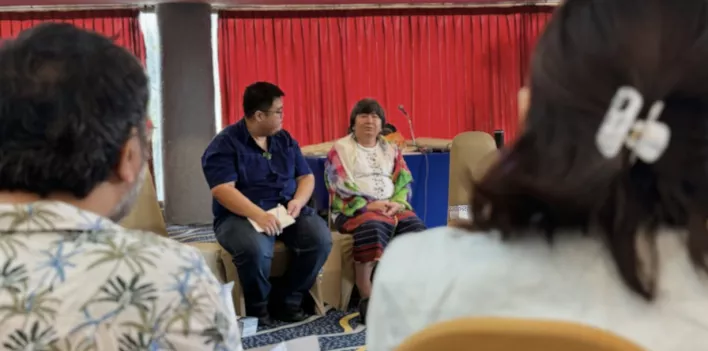
The discussion underscored that preventive protection requires more than distributing information. It means listening to communities, considering the risks of different advocacy strategies, and supporting defenders to determine how they want to respond.
The question that opened the workshop remained central: what could communities do differently with information months in advance? The participants’ experiences showed why timely information, combined with community-led strategies and careful protection planning, matters for a just energy transition.
Learn more about IAP’s work on defenders and Defender Alerts. Defender Alerts operate with the collaboration and guidance of our core group members from the Business and Human Rights Centre, Peace Brigades International, the Coalition for Human Rights in Development, and Indigenous Peoples’ Rights International.